

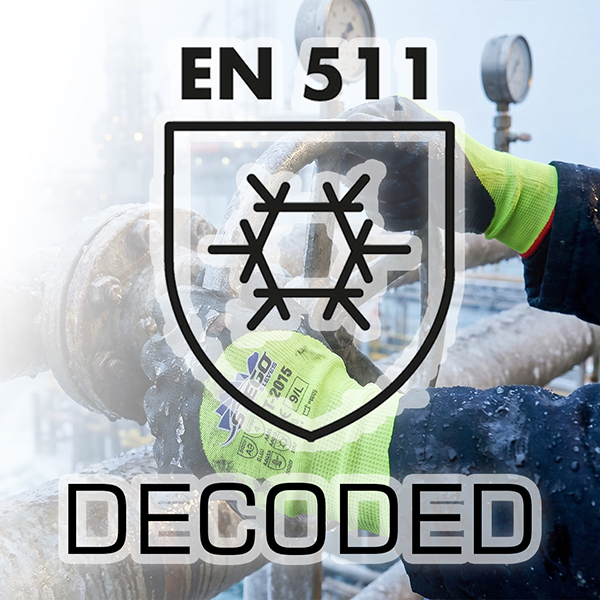
Reading cold protection — convective, contact, and water, and what each one actually commits to
A cold-rated glove carries three separate scores, not one “warmth level.” Two of them measure completely different physics, and the third is pass/fail. Read it as a single number and you can hand out a glove that’s well-insulated against wind chill and still lets a worker’s grip fail on a frozen valve.
The hook: warm is not one thing
Ask an EHS buyer to compare two winter gloves and most will look for the highest number on the label and call it done. But EN 511:2006 doesn’t report “how warm” a glove is — it reports three independent test results stamped together because they fit on one pictogram. A glove can score well against moving cold air and score poorly the instant a hand touches a cold steel rail. Another can insulate well both ways and still fail outright the moment it gets wet. Read the three-digit code as one “cold score” and the glove that looks strongest on the label can be the wrong glove for the actual exposure on site.
The decode: what each position actually tests
| Position | Hazard | Method | Scale |
| 1 — Convective cold | Heat lost to moving cold air around the hand | Heated hand model in a refrigerated chamber; measures power needed to hold the hand’s surface at a steady temperature | 0–4 (higher = better insulation) |
| 2 — Contact cold | Heat lost the instant the glove touches a cold object or surface | Thermal-resistance test between plates at different temperatures | 0–4 (higher = better insulation) |
| 3 — Water penetration | Whether water reaches the hand during wet exposure | Timed immersion of the fitted glove in water; pass only if no water penetrates | 0 (fails) or 1 (passes) |
Three literacy points buyers routinely miss:
Convective and contact cold are different physics, not two versions of the same rating. Convective cold strips heat from a
hand in cold wind or open air. Contact cold strips heat the instant skin or glove touches a cold solid — a chilled valve, a frozen rail. A glove with a thick air-trapping liner can score well against convective loss and still transmit cold fast on contact if its palm is thin. Match the position to the actual exposure — cold-air work needs position 1; handling cold metal needs position 2.
X can appear at any position, and it isn’t a failure. X means that specific test wasn’t performed, not that the glove was tested and came up short. A marking like “3X1” would mean convective cold was tested and rated (3) and water penetration passed (1), but the contact-cold test wasn’t run — a gap in what was tested, not evidence the glove fails on contact.
X and 0 are opposites, not siblings — the same misread as on the EN 388 shield. 0 at position 1 or 2 means the glove was
tested and didn’t clear the Level 1 threshold. X means the test wasn’t run at all. Reading a 0 as “not tested” gets it backwards: 0 is a documented result, X is the absence of one.
What EN 511 doesn’t tell you
The standard is narrower than most buyers assume. It says nothing about dexterity or grip — a glove can score well on cold protection and still be too stiff for fine work; dexterity is rated on a separate spec line, under the general-requirements standard (EN ISO 21420), not this one. It gives no exposure-duration or temperature guidance — a contact-cold result is a lab measurement, not a “safe for X minutes at Y°C” promise; matching a rating to an actual shift and ambient temperature is a workplace risk-assessment question, not something the label answers. And the water-penetration score is binary, not graded — it only confirms the glove resisted water during one timed immersion; it says nothing about splash-only exposure or how resistance holds up with wear.
Reading a real glove: ST-6075 STEGO’s TEGX™ Cut Defender Arctic ST-6075 is a useful literacy example because its public Article Data Sheet carries a full three-digit EN 511:2006 marking alongside its separate cut-protection rating: 1 convective cold, 2 contact cold, 1 water penetration — read together as 121.
That code tells an EHS buyer something specific: ST-6075 isn’t a heavy winter mitt built to hold heat in still air — its convective score is modest — but it holds up better on direct contact with a cold surface, and it keeps water out. That fits the job: a cutresistant glove for handling sharp material in a cold environment, where contact with the object being handled is the dominant exposure, not standing in open wind. (The companion EN 388 mark on the same ADS also reads “X” at its position 2, deferring to the TDM letter — an X that points to the governing result rather than marking a failure, a different standard, same glove.)
Practical takeaways for an EHS selection review
- Identify which cold exposure the task actually creates — moving air, contact with a cold object, wet hands, or a mix before comparing gloves on a single digit.
- Never treat the highest number on the shield as the whole story. A strong convective score says nothing about contactcold or water performance.
- Read an X as “not tested for this,” not “failed.” It narrows what you can claim about the glove — it doesn’t disqualify it for exposures the tested positions do cover.
- Confirm position 3 before wet or humid work, and pair the EN 511 mark with the glove’s other ratings rather than reading it in isolation — cold, cut, and chemical protection are separate commitments on separate lines.
Where STEGO fits
STEGO publishes the full three-digit EN 511:2006 marking on every cold-rated Article Data Sheet — each position reported honestly, no digit rounded up or implied. That discipline runs from the same “Decomposition of Risk” approach behind every STEGO glove: start from the actual hazard the task creates, then rate the glove against it, rather than marketing a single “warm glove” claim. Reading the code correctly is the buyer’s half of that discipline.